Monday, May 10, 2010

New York City … let the tours begin


I am visiting NYC this week with a group of advertising students from the UO SOJC. It’s an incredible group of people led by an incredible professor (Deb Morrison) visiting incredible agencies in this incredible city. I’ve just completed day one and I’m already in awe of my surroundings. There is an indescribable energy in the air. It thrills you, intimidates you, and motivates you to do something.

Today we had the opportunity to visit and speak with Euro RSCG at their PR and pharmaceutical advertising branch. Check this place out – they’re pretty incredible. In 2009, Advertising Age listed them as #2 in the top ten best agencies. They do traditional marketing as well as some pretty incredible creative business ideas that develop a company or organization outside of its direct-to-consumer marketing.

The entire visit to Euro was fantastic, but there was one topic in particular that really stuck with me. A fellow student asked how we might better foster relationships between the account and creative sides of a campaign. Coming from a PR/planning background, I can definitely relate to the tension that forms between the creative genius and the logistical multitasker. Naturally, the advice offered was to work together. If the strategy is developed and/or discussed between everyone beforehand, each element can be more secure in what he or she contributes to the overall project.

Here’s the key point: you have to be confident in what aspect of the project you are representing. Our advice to planners was to not be afraid to discuss and suggest creative elements, and vice versa. Personally, I have a tendency to back down against someone who I feel ‘knows more’ than I do. Leadership and management roles have always come pretty natural to me, so I tend to disregard it as something easy in comparison to other more intimidating aspects. But you know what? Some people can’t get their shit together. I’m proud of my color-coded planners and will try to respect my coordinating, aligning, rearranging, constantly churning brain as a skillset that I can bring to the world. And believe it or not, I'm creative too. It just doesn't always express itself as boldly as others.

So thanks, people of Euro RSCG, for helping turn my neuroses into selling points. Because if I got them, I might as well use them for the better.

Friday, May 7, 2010

Collective cultural histories: an archive merging the past, present and future

As a concept, history is a record of past events. So what happens when history merges with the present? When we begin to publicly record our daily thoughts and activities with public status updates, we are actively recording our (global) culture’s history. It may seem trivial in the moment, but think how meaningful these candid broadcasts will be to society a century from now? Imagine what an archive of conversation will reveal about our social structure, interaction, and communication. What will be the overall themes of global thought?

These are the questions that a group of historians with the Library of Congress are hoping to answer. As this New York Times article explains, Twitter has given its archive of public messages to the Library of Congress for a historical archival project. These historians are now faced with an enormous collection of personal anecdotes that will only continue to grow. This project has an incredible amount of potential. As one source stated, “Twitter is tens of millions of active users. There is no archive with tens of millions of diaries.”

I am fascinated by this project. As a history buff, I am captivated by the lessons we can learn by turning to our collective past. What bothers me most about the historical field, is how there is often a disconnect between the academic study and a consciousness of the present moment – pop-culture, technology, and all.

I think the relationship Twitter has formed with the Library of Congress is a step in the direction we will be moving as a culture. More and more people are recognizing the potential power clutched by social media, interactive media, and whatever social communication channels the future will offer.

Monday, May 3, 2010

Mandatory tweets?

Social Media – the final frontier? Recently, I’ve read several articles addressing the impact that social media channels are having on our lives, relationships, and professions. On one side, I’ve heard that the whirlwind of social media is preventing us from fostering and nurturing real-life connections. From others, I hear that it is absolutely necessary to promote your name as much as possible into the ether or else you won’t find a job. Surely, there must be a happy medium.


Quite frankly, I don’t get the hype. I think the rapid evolution of communications is absolutely fascinating. I also think it’s incredibly important to stay atop of these changes if you wish to be a part of the communications industry. What I don’t understand, are the two extreme takes on this (sort of) new phase in the way we connect.

To those who seem shocked or overwhelmed with interactive media – catch up. Are we really that surprised that communication is changing? Language evolves, cultures evolve, it’s only natural that they way we relate to one another is too. I was not one of the first members of Twitter, but I caught on, got used to it, and found my own way to contribute.

Now, to those who think social media platforms will save the world – they won’t. They will change the world, but only in many small and individual ways.

One article on Social Media Today summarizes the debate pretty well by presenting two arguments on whether or not social media should be a required skill for PR professionals. The first author, Kasey, thinks social media is great for some, but isn’t right for others and shouldn’t be touted as a necessity. Rachel, the responder, seems to think that is the point. Interactive media channels are not right for every audience or every business, and that’s why professionals need to understand them.

So in sum, know your stuff. If you would rather not update your whereabouts on Gowalla, that’s a choice. But you better understand how it works and why others may want to utilize it. If you would rather not maintain a personal blog, feel free, but learn how blogosphere communities work. But … what’s a better way to learn, than to do?

Creating Community

What makes us feel connected? What makes us feel engaged? I’ve been pondering these questions a lot lately, partly for my own self-betterment, and partly for different projects I’m working on right now. Out of context, these questions are pretty vague. However, they are also the most important to address when trying to understand a community, learn how they work, interact, and where there is the potential to develop.

Let’s use Eugene, Ore., as fun example to test out these questions. Eugene is a warm, inviting town that anyone can quickly call “home.” However, like every home, there is always something that needs to be fixed, sometimes tension between generations, and every once and a while … it’s just a big mess.

I’ve called Eugene home for most of my life. At times I feel a loving comfort from its familiar faces and spaces. But sometimes I also feel a disconnect. I sense the mounting tension between the wealthy and the desperate, the young and the “mature,” and those who wish to evolve and those who fear change. How can we overcome these groups individual isolations and come together as the engaged, proactive, united community that I know we all wish it to be.

Maybe it’s just my wishful kum-bay-ya approach to life, but I really feel that the more opportunity people have to contribute, the more they will. If you reach out to someone for help, more often than not he or she will come to your aid. Why don’t we take this approach to the whole community? Let’s let people create the change they desire, let’s let people have fun.

I work at the Eugene Saturday Market. Every week the Eugene Park Blocks attract people from all scopes of life who talk, listen to music, eat, and most importantly – enjoy the company of their community. How can we apply this sort of all-inclusive feeling to every day life?


A year or two ago I discovered the legal graffiti wall behind Amtrack on Shelton McMurphey Blvd. What a great idea this is! Eugene already loves its murals; what if there were more spaces for continuous, expandable, adaptable, engaging outlets of creativity? Let’s not reserve our communal artistic aesthetic for planned programs. I want to see a space for anonymous expressions of creative thought. I want to see a visual conversation created between two people who may never meet. What would it matter if someone abused the free space and painted something obscene? They would only be adding to the discussion, and someone else could come along and challenge it with a fresh coat of expression. The current graffiti wall is a fantastic start, but it’s pushed to the edge of town – out of site, out of mind. Let’s push community involvement and interaction to the front of our minds.

This is just one way in which we could become a more engaged community. There are many more out there, and even more brilliant-but-untapped minds who can provide their thoughts. Don’t ignore the tensions of a community, let’s address them and create an opportunity for involvement. Let’s make our town a home.

*Photos by rerinha and Dynamic Street Art

Friday, April 23, 2010

The Schmooze: segue to success or social anxiety?

We all hear that networking plays a vital role in finding and maintaining work. The pressure mounted on students to expand their professional communities is immense. And should be. The media industry especially touts networking as such a necessity. But really, meeting people and making a lasting impression makes a difference in any field. Having a wide resource of many different talents, minds, and perspectives is a benefit.

Jeremy Porter of Journalistics recently posted his advice for building and strengthening your networking community. He approaches it from the angle of journalists and public relations practitioners, but I feel that a lot of his advice can apply to any industry. Whether or not you work in the media, with the community, or within an organization, it’s always great to, as Porter says, “know somebody that ‘does that’ or ‘works there.’” Say you’re going for a research grant to do some work on your dissertation … how great would it be if you already knew some of the people in the loop and they were familiar with the great work you’re doing? You don’t have to be a media guru to benefit from a little schmoozing.

These are three of Porter’s tidbits that I found most intriguing:

Have a Good Opener – you’re going to have to introduce yourself at a networking event. You should be able to answer the “what do you do?” question consistently, with a clear and memorable message. It doesn’t hurt to prepare this statement and practice it – just don’t sound like a robot when somebody asks you (unless of course you are a robot).

I need to do this. I have many thoughts bumbling around in my brain, but I struggle to articulate them without context and explanation. It doesn’t really matter what you do, your interests don’t have to mirror your potential contact. Expression your passion and think of a way to connect it to someone else’s.

Deliver Value – I’m pretty passionate about this point. I regularly scan my contacts to see what ideas pop into my head. If I come across some information that would be interesting to one of my contacts, I share it with them. If I see synergies between people in my network, I share it. If somebody asks me for help, I offer it willingly. Don’t miss the opportunity to pay it forward, you’ll feel great and will find people often reciprocate.

What better way to show people that you care then to reach out and offer something of their interest? And what better way for people to get to know yours?

Everybody is Important – the Barista at Starbucks? She’s working on her MBA and is going to be your boss in five years. The guy working on your car? He’s going to coach your kid’s soccer team next season. And that woman wanting to interview you for her school paper? That’s the CEO’s daughter. Everyone is connected. Never – never ever – assume somebody is not relevant to the type of relationships you’re looking to build today. You never know who will be important, so assume everyone is.

Honestly, I think this is a good life lesson. We should really all treat each other as valued, important individuals that be of benefit to someone else. This statement is also related to Porter’s advice: “Don’t Judge.” Even if you don’t connect with someone you meet as a friend, you never know how you could help each other out in the future. Let’s treat the whole world like a potential resource of friends willing to lend their skills for the benefit of others.

Go here to read the rest of Porter’s insight and think how it could apply to your life.

Wednesday, April 21, 2010

The Art of Presenting

This past weekend, I had the opportunity to give my first academic presentation. Yes, I managed to stand (that alone was tricky enough) in front of a room of sweater-clad, book-toting, eye-glass-wearing academics and present my research on three Maya relief sculptures. Yikes. Looking back from the more comfortable post-talk perspective, I have to say it was one of the most thrilling and rewarding experiences I’ve had in college so far.

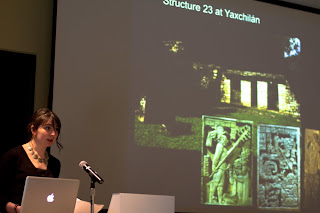
For those who don’t know, I was invited to speak at the UO Art History Department’s annual symposium. That's me below. It's hard to look suave with your mouth open. The theme this year was “Art and Ritual,” which felt like the perfect fit for my work on bloodletting rituals in Maya sculpture. Hooray for me - I was one of seven students (bachelors, masters and doctoral candidates) chosen to speak from a national call for papers.

If have to pick one thing this experience taught, it’s that crafting a presentation is a lot more difficult than I expected. I read as many articles, blog posts and tip sites as I could find on creating and presenting a spoken paper, all of which provided me with at least one insight I would have never thought of before. I also realized that while this was a wonderfully nerdy niche symposium, I learned some skills about preparing a talk for an audience that could extend into any future situation. Whether you’re crafting a presentation for academia, a client sales pitch or an informal class talk, I believe there are some general tips that can help.

So while I may not be a seasoned professional (yet), I thought I would contribute my top five takeaways from my experience. Some I did well. Some I will do better next time.

Prepare for everything. Expect anything
I am a planner … For better or for worse. In this case, my need to feel prepared served me well. In addition to your talking points or scripted speech, have a list of things that might come up. What questions could people ask? What are additional facts that are interesting, but may not flow in your presentation? Remember, no matter how much you may rehearse, something may not go to plan. Be mentally prepared for anything. I was called up to speak twenty minutes before I was scheduled to begin. The trick is not to let it get to you. I knew I had my speech down, and I knew my slides were ready to go. Prepare for what you can, and be ready to let the rest go.

Start sexy

This advice was offered by my incredible professor/mentor. Of course, this is more metaphorical than literal. Begin your presentation with a bang to grab the audience’s attention. A boring introduction suggests it will be a boring talk, so convince your listener from the start that there is a really good reason to listen. I like to compare it to a movie preview – it really just summarizes the film, but uses words with just enough drama to get you interested.

Believe in your words

You have to commit to yourself. If you feel unsure of what you’re presenting, the audience won’t want to listen to your argument. I received some great advice from Paul Viel, who said, “Remember, they are totally interested in everything you’re saying.” It’s tough to build up the confidence to mentally expose yourself to a room of people, but I convinced myself that everyone would be as captivated by my topic as I was, which helped me keep up the energy and enthusiasm to make it through.

Use your friends
Practice in front of anyone and everyone you can. Believe me, I know that Mr. Desk and Mrs. Pillow are a far more comforting audience, but they don’t offer the feedback, or even the pressure, that you need to succeed. I felt pretty satisfied with myself a few days before my talk … and then I spoke in front of seven people and had the rude awakening that I talk way too fast, it’s really hard to read a script while you’re standing, I have a tough time articulating specific words, and that I was a lot more scared than I thought I would be. My trouble spots stuck out like neon signs under the pressure of having a few people standing in front of me. Even if your material is perfect, it’s helpful to get used to the feeling of others watching you speak.

Wait … there’s a screen behind me?
Even in a more formal, scripted environment, it’s still important to interact with the images on the screen. This is something I probably could have done better at. I had rehearsed enough to be able to look up from my paper, but when it came to use the laser pointer I received at the podium, I was lost. I think some of my points could have been clearer, or at least more exciting, if I had been able to engage with the images behind me more. If you are glued to the podium, at least remember to let your body express what you’re saying.

Mind map it
Maybe this is just my problem, but I found that as I was reading I would get too absorbed in the individual words, and forget the birds-eye view of my presentation. It found it really helpful to have a little outline off to the side to keep my mind in check on where I was, and where I was going with my argument. I also segmented the paper I was reading from, to alert myself

All in all, be yourself. Presentations can be tough, but well worth the work. After proving my academic worth to the symposium attendees, I feel a bit more relaxed in a room of peers. So buck up and show the world what you have to offer.

Wednesday, April 14, 2010

Motivate me

This blog is boring.

Negative? Yes. Relatively true? Yes. I haven't given this blog the proper nurturing that it deserves. It's like a sweet little starter plant that you buy when the sun starts peaking out in April and you have all of the best intentions. But then it sits on your porch for a few weeks, occasionally gets a gulp of rain, and eventually collapses.

This spring is going to be different. I'm currently enrolled in a class that's asking me to engage in my niche blogosphere community, and I'm determined to do it. Essentially, I now have homework to do what I've been trying to do on my own for over a year. I'll admit, it's hard to brush off the self-disappointment that I couldn't get the time/motivation/inspiration to put my thoughts out there by myself, but I'm pleased that I'll at least be able to do it.

There will also be a bit of a shift in content. I still want to contribute my own experiences and inspirations, but I will also be including more perspective from the communications side of the art world. It's one of the many topics that grab me, but often the one that gets tossed aside first when it comes to articulating my thoughts.

So ... here's to Spring and the potential it brings.